Lake Atitlan, Panajachel, Guatemala

Tuesday, October 9, 2012

Guest post by Kate Palmer-- "The writing book that changed my life"


There are a handful of books I consider must-reads for anyone serious about getting published. Scene and Structure by Jack M. Bickham tops the list as the one book I credit with improving my writing the most.

Bickham was a student of Dwight V. Swain author of Techniques of the Selling Writer. His methods aren’t that different from Swain’s, and many are exactly the same. Bickham, however, is a gifted teacher.

Scene and sequel are referenced by many an editor and author. Bickham explains that today’s books must be written in scenes to appeal to the modern audience.

First, we must understand that scenes happen in real time. A scene is made up a goal (for the viewpoint character), conflict with about four twists and turns, and ends in a disaster for the viewpoint character. The disaster can take the form of

1.      Yes, she accomplished her goal, but . . . something that makes the situation worse, more complicated, etc.
2.      No, and furthermore . . . something that makes the situation worse, more complicated, etc.
3.      No
So the structure of a scene is:

Goal-Conflict-Disaster

A day before my book was scheduled for typesetting, I received a note from my editor asking if I could use more show and less tell in a particular chapter without adding a lot of words. I read through the chapter and nearly cried. It. Was. Awful. I had apparently skipped it entirely when I’d edited my book for scene and sequel according to Bickham’s structure.

The chapter consisted of several short vignettes which showcased character traits or provided information crucial to the plot. I knew I had to rewrite it according to Bickham’s scene structure to provide the show not tell my editor requested. I ended up merging three of those vignettes into one scene happening in real time with all of the characters present. Far from adding to the word count, this technique helped me to cut HALF of the chapter and still preserve all the critical information.

Each scene is followed by a sequel.

This is where the reader truly gets to know the viewpoint character. My main character is named Eva. My beta readers kept telling me they wanted to be inside Eva’s head more. When I started writing sequels according to Bickham’s method, my readers finally understood Eva’s motivations and actions. The structure of a sequel is:

Emotion-Thought-Decision-Action

This is where we see inside the character’s head. The character has just experienced a setback (the scene ending disaster) and will be feeling emotion first. What type and how long depends on your character. Next, the character will become a bit more rational in that he/she can think about what just happened and consider where to go from here. Naturally, your character will make a decision based on the emotion (first) and thoughts (second) he/she just experienced.

That decision will come in the form of action which will launch your character into the next scene complete with a new goal of what he/she needs to do next. Of course your character will meet with more opposition (conflict) that ends in disaster for the scene goal. Doubtless this will stir up emotions for your character who will then have to consider (think about) his/her circumstances and make a new decision for more action (new scene and goal).

And on it goes until a scene doesn’t end in disaster and some form of resolution is met for your character and you type The End.

I’ve only touched on a couple of key components taught in Scene and Structure by Jack M. Bickham. I highly recommend anyone serious about writing buy his book and read it with a highlighter. At least twice.

Thank you, Kate! For information on Kate Palmer's debut novel, The Guy Next Door,  please see her website, katrinapalmer.com.


Kate began her career as an elementary school teacher, but was soon promoted to full-time mom. She is the mother of six and lives in the country. Her husband is trying to teach her to be a farm girl. She can’t saddle a horse, but she knows how to butcher a chicken. After a day of chasing children, cooking meals, and doing laundry, she likes to escape into a good book.

Tuesday, August 21, 2012

Painted Horses

Okay, all you Rats, Toads and Moles out there, thanks for commenting on my last (399th) post and identifying yourselves. It was fun reading your comments! And just as expected, I couldn't wait long to post again. Especially since my husband and I had an adventure, and I have pictures.

And only an hour away from home, too-- the city of Ogden, the best kept secret in Utah. No crowds, no traffic, not a destination spot. But for us, it's our new favorite place.

Because among other attractions, how can you not love a city that has statues of painted horses lining the downtown streets?


I was going nuts seeing these horses, naming them, taking pictures, petting their darling noses. Like this pale one -- so cute I just wanted to take him home with me. Look at that sweet face! I named him Cute Horse, not very original but he was just too cute to be named anything else:


What do you think of Money Horse? Not my favorite because it seemed embarrassing for poor Money Horse to have dollar bills painted all over him, but still, it's a clever idea.


There are so many more, I didn't get pictures of them all. But you must see Dinosaur Horse!


 And then I love this one that looks so noble and grand and majestic--


It has our nation's founders-- Thomas Jefferson, George Washington, John Quincy Adams and two more I can't remember. It's very cool and probably my favorite.

Most tourists to Utah will see Temple Square in Salt Lake City, Zion's National Park, the Bingham Copper Mine, Park City, Moab and the Arches, the Great Salt Lake-- there is more to see in this great state than one could imagine-- but don't forget an out of the way place called Downtown Ogden, where the painted horses are waiting.

Monday, April 30, 2012

Zoology is a Limited Demographic

Write what you want but realize that if you write a book that has a very limited demographic-- a zoology textbook, for example-- that you're not going to get many Kindle sales. In fact, publishers determine how best to market your book based on the demographic.

And thus ends the shortest post of the month, because I am all alphabetized out. I can hardly believe it's the last post. It's been really fun to write 30 posts about The Making and Selling of Books.

Congratulations to all the A to Z-ers! I have the Linky List on my sidebar and plan to continue my blog visits following down the list. I've found some amazing new bloggers this month. This has been a fantastic Challenge this year. I have loved participating and being part of the hosting team.

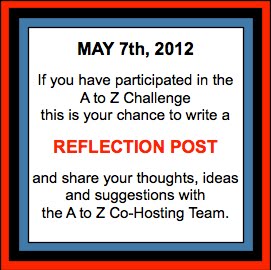
And don't forget May 7, when we can all write a post reflecting about our experiences with the Challenge.


Friday, April 27, 2012

Giving it that something X-tra

                                                                    Go the extra mile

         do your best work
           
                        don't be satisfied with mediocrity

                  give it your all

                                                       work your butt off..........

if you want to get published and sell books.

                                                                               And having a bit of talent won't hurt either.

Thursday, April 26, 2012

Why be a Writer

If you want to be famous then run for office and be a politician

If you want to be rich then become a plastic surgeon.

If you want to have people know your name then be a teacher.

If you want to make a difference in someone's life then have children.

But if you want to work alone, feel like a freak, be misunderstood, wonder what the point is, always come up short of time and money, while writing stories that bubble up from within about characters you have never met but are strangely in love with, then be a writer.

Wednesday, April 25, 2012

Voice and the Refining of the Author's Voice

If you want to make a book, like if you want your book to get picked up by a publisher who will invest money into editing, design, printing and marketing and all that, then you need to have an appealing and strong author voice.

By that, I mean that certain something that shines through the plot, the characters, the description and every other part of your story and comes to rest upon the reader in a pleasing way.

It is much like person to person communication. I can sit down and talk to you and may have something interesting and important to say but if you don't like my tone or my facial expressions or the way I constantly smack my lips while speaking or never make eye contact or talk with my mouth full then it's not likely you'll want to listen to me for very long.

Voice is like that. If it is clear and strong and true it connects with the reader, who will then be more than willing, even eager, to continue this journey of discovery within the pages of the book.

How to get a distinct author voice? There is one way and one way only. It comes with practice. Write write write and write some more.

Tuesday, April 24, 2012

Undercurrents of the Book Launch

Launching a book is comparable to launching a ship out on the open sea. Who knows what will happen out there on the great big blue ocean?

With every book launch, the undercurrents are there, positive or negative or some of both.

There can be undercurrents of jealousy how come her books sell better than mine
Of bitterness if only my publisher had done a better job with the cover or with marketing or with title choice
Of high hopes when Oprah calls....
Of despair nobody will buy it and if they do won't read it and if they do will hate it
Of  pure joy I'm published I'm published I'm published
Of doubt should I have gone with this publisher, should I have self-published, should I do more with my blog, should I be active on Kindle Forums
Of confusion I want my book to be successful but don't know what to do next
Of satisfaction this book is awesome and I can't wait to write another

There are many shifting and varied undercurrents that carry a book out into the wide open sea, where anything can happen.

Just remember as you're riding those currents to enjoy the journey!

Monday, April 23, 2012

Typesetting a Book

I don't know how to do typesetting but I appreciate those who do. It takes a certain kind of highly detail-oriented perfectionist to be a good typesetter.

Typesetting is key in making a print book. It comes after the editing and before the printing. It has to do with fonts, spacing, white space, chapter headings and things you don't really notice when picking up a book but that add to the enjoyment of the reading experience.

When the typesetter is done, the publisher will get a print-ready proof to look over, to send to the author for final review, and then, when all corrections are made, to submit to the printer.

Book is printed, voila! Another book is launched out into the world of happy readers.

Hooray for the skilled typesetter!

Saturday, April 21, 2012

S is for Saia, Submissions and The Soul Seekers

I ran a submissions contest a year or so ago on my blog for WiDo and one of the entries was from Amy Saia. It didn't win, but the submissions editor loved the first chapter!

At some point, Amy was asked to rewrite and resubmit. She worked super hard on it and got a contract for publication of her YA paranormal, The Soul Seekers to be released by WiDo Publishing on August 7.

And check out the very cool cover, designed by the author, the multi-talented Amy Saia.


When Emma’s father dies, she and her mother move cross country to live with Gran. Now the only constant in Emma Shay’s new life is him. Beautiful, silent, him—the mysterious guy at the library she secretly calls Superman because of his dark, good looks. Emma is puzzled and intrigued by this boy’s behavior. He speaks at her but never to her. He comes up to touch her hair and then suddenly leaves. An impulsive meeting between them uncovers a strange truth. Only Emma can see time-frozen William Bennett. Now it’s up to Emma and the gift she has tried so hard to deny to reclaim William’s soul. But ghosts can be very stubborn. He tells her to leave town and forget he ever existed. Not on your life, Superman.  

Set in Southern Indiana during the summer of 1979, The Soul Seekers is about one girl and the ghost only she can see. Can she bring him back from his purgatory, or is she doomed to turn into a ghost herself?

The Letter S is also for SALES, because I hope that The Soul Seekers gets lots of them!

Friday, April 20, 2012

Reviews and Reviewers

I love to get reviews posted on Goodreads and Amazon on my books, because then I know people actually read them. I'm always eager to know what people actually thought about them.

The first bad review I got really hurt. In fact, I got several early on with Uncut Diamonds. Ouch, ouch and ouch. They don't bother me now. In fact, sometimes I like to just go and look at them again: "hated it." "losey book." They make me smile. I think it's funny that someone found my book so horrible and even funnier that they felt such strong enough emotions to go to the trouble to post their two-word negative response.

I could spend hours scanning reviews on Goodreads and Amazon. Not on my books. I don't have enough of them to take hours, minutes maybe. I just like to read reviews. Some are gushing wonders, others horrible slams-- all for the same book!

One thing it shows is that there a whole lot of readers out there and they don't all like the same thing. It also shows that the more people are reading a certain book, the more reviews it will get of both good and bad variety.

Writers love getting reviews, especially glowing, five-star reviews. One of the very best ways to love an author is to post a review!